English Is Important, But So Are Indian Languages!
posted on Aug 28, 2026
Gurukul The School, the best CBSE school in Ghaziabad, we believe language isn’t simply a tool of communication. It’s also a medium through which children express their feelings, understand local stories
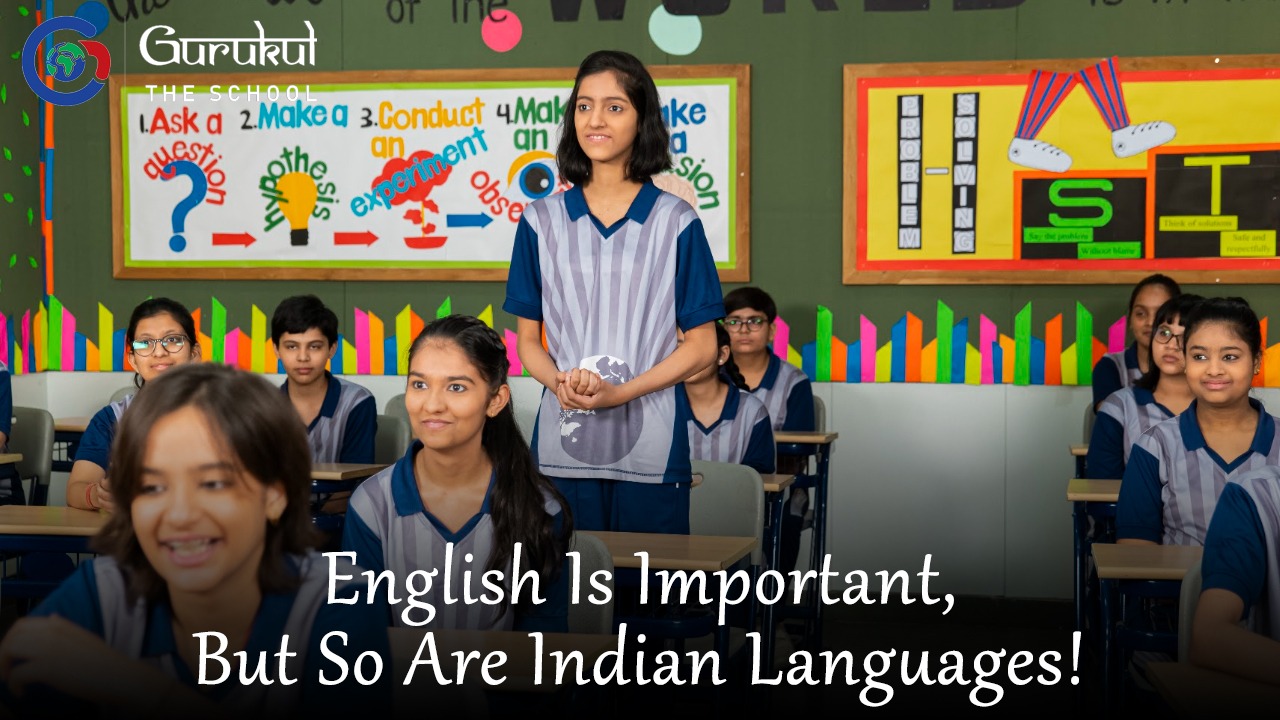
English has long been an important language in India’s education landscape. Whether it’s school textbooks or online resources, you’ll mostly come across learning material created in English.
While it’s a great tool for academic and professional success, it isn’t the best medium to connect deeply with people who aren’t as fluent in English. In such cases, you’ll need to be fluent in your mother tongue or other native Indian languages. This is exactly the reason why CBSE came up with its 3-language policy.
Today, in this blog post, let’s discuss why today’s children should be as fluent in native Indian languages as English. So go ahead and read to the end.
India is a Linguistically Diverse Country
India has 22 officially recognised languages other than English, including Assamese, Bengali, Hindi, Tamil, Marathi, Gujarati, Punjabi, Oriya, etc. If your kids are only fluent in English, they may struggle to interact smoothly with other countrymen.
At Gurukul The School, the best CBSE school in Ghaziabad, we believe language isn’t simply a tool of communication. It’s also a medium through which children express their feelings, understand local stories, participate in family conversations, and try to make sense of their surroundings.
Since kids grow up hearing and speaking their mother tongue, it will always be a better medium for connecting with their grandparents, folklore, and other people in their region.
Native Indian Languages Deserve to be Prioritised
As a parent, you may ask why my children should develop fluency in native Indian languages when the academic and professional landscape requires English for success. Whenever such questions are asked at Gurukul The School, we emphasise the importance of Indian languages through the following points –
- Native languages give children a deeper connection with family
While English is undeniably the dominant language in schools and the professional world, it doesn’t hold the same place in Indian households. In such cases, Indian languages stand out because they’re the language of grandparents, relatives, and everyday family conversations.
Knowing it allows children to communicate with family members more naturally. It also lets them participate in stories, humour, traditions, and memories that may not translate fully into English.
After all, a child’s life isn’t limited to their academics and career alone. So, if you want your kids to have a fulfilling family and social life, you must encourage them to prioritise native Indian languages as well.
- They help children understand their own cultural context
A language carries references, expressions, stories, and ways of describing experiences that are rooted in a particular culture. Learning an Indian language therefore gives students direct access to India’s rich literature, folklore, poetry, history, and traditions.
Languages like English can only introduce cultural heritage through a generic lens. If you truly want your kids to connect with their cultural roots and experience the rich cultural heritage, then being fluent in a native Indian language is a better option.
- They make children more adaptable in a multilingual country
India’s linguistic diversity means children will inevitably encounter people who communicate differently. So, knowing an Indian language beyond English can help children navigate different regions, communities, and social gatherings more easily. It also teaches them that effective communication is not always about speaking the globally dominant language.
- They give children a broader sense of language & identity
Knowing only the language most associated with education or career can narrow a child’s linguistic world. When kids learn an Indian language alongside English, they experience different ways of expressing ideas, emotions, and relationships. It helps them understand that being educated and being connected to their linguistic roots are not opposing identities.
There’s Never an Either-Or Situation
Some people mistakenly believe their kids can choose only English or an Indian language. In reality, there’s never such an either-or situation. In fact, CBSE’s new three-language policy makes it easier.
According to CBSE’s three-language rule, a student must learn two native Indian languages. The remaining one can be a foreign language; this is where they can choose English. So, pick any combination that prioritises your child’s mother tongue, English, and another native Indian language.
Frequently Asked Questions (FAQs)
- What native Indian languages can my children choose under CBSE’s three language rule?
- They can choose any two languages from the 22 officially recognised languages published on the Rajbhasha portal.
- Is Tamil + English + Sanskrit a valid language combination?
- Yes, it is. If your school provides these options, your kids can proceed with it.
- Will schools stop using English under CBSE’s new rule?
- No, they won’t. English is still one of the languages that can be used for learning. However, the other two languages must be native to India.
Conclusion
Every language has its own distinct advantages. While English is a globally accepted language that can open doors to wider academic and professional opportunities for our children, Indian native languages help children stay connected to their roots. Hence, the two need not compete for space in children’s education. Rather, they complement each other in providing children with holistic developmental opportunities.
At Gurukul The School, regarded as the best CBSE school in Ghaziabad, we believe that education should ideally prepare children not only for academic and professional success but also for life beyond school. Only then does education become truly meaningful, and this is exactly what CBSE’s 3-language policy has been carved for.
So, by means of this blog post today, we would like to urge all parents to encourage their kids to give equal attention to both English and native languages. This small step on your part will make a huge difference in helping your kids bloom into confident and culturally connected individuals.